
Abstract Philosophical Questions
Abstract philosophical questions explore concepts that exist beyond physical reality — ideas about existence, perception, truth, and the nature of thought itself.
An abstract philosophical question is one that deals with concepts rather than concrete facts, often exploring ideas that cannot be easily observed or measured. For example, it might ask about the nature of existence, the meaning of life, or the concept of free will. These questions typically provoke deep thought and discussion, as they don’t have straightforward or empirical answers.
Unlike everyday questions that seek factual, definitive answers — such as “What is the capital of France?” — abstract philosophical questions invite multiple interpretations, challenge assumptions, and push us to examine the beliefs we often take for granted. Philosophers from Socrates and Plato to Descartes, Kant, and Nietzsche have dedicated their lives to exploring these very inquiries.
Abstract philosophical questions span every major branch of philosophy: metaphysics (the nature of reality), epistemology (the nature of knowledge), ethics (right and wrong), aesthetics (beauty and art), and logic (the structure of reasoning). They are essential because they shape our understanding of the world and our place in it, helping us develop critical thinking skills and gain deeper insight into what it means to be human.
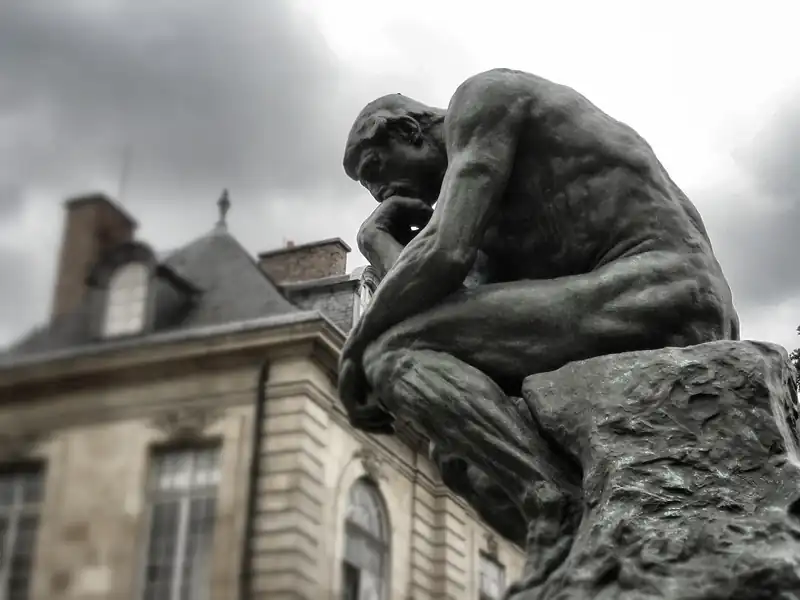
Below are 50 of these sorts of abstract questions. If you’re a teacher, a student, or simply someone who enjoys thinking deeply, each question includes a brief explanation and a scaffolding prompt to help you explore it further.
50 Abstract Philosophical Questions
1. What is the meaning of life?
The meaning of life is subjective and varies from person to person. Some find meaning through relationships, achievements, or serving a higher purpose. Others believe that life’s meaning is something each individual creates for themselves through the choices they make and the values they hold.
Scaffolding Prompt: Can you think of a time when you felt your life had a particular meaning or purpose? How do different cultures or religions view the meaning of life?
2. Can happiness be measured?
Happiness is notoriously difficult to measure because it is deeply subjective and varies greatly between individuals. Self-reports and psychological surveys can provide insights, but they may not capture the full picture. External indicators like health, income, and social relationships also play a role, though they may not always align with personal feelings of happiness.
Scaffolding Prompt: What are some ways you measure your own happiness? Do you think wealth or success can determine happiness — why or why not?
3. What defines a person’s identity?
A person’s identity is shaped by a complex combination of genetics, environment, experiences, and personal choices. It encompasses personality, beliefs, values, and the social roles we inhabit. Identity is dynamic — it evolves over time as people grow, learn, and face new challenges that reshape how they see themselves and the world.
Scaffolding Prompt: How do you think your identity has changed over the past few years? What factors do you think are most influential in shaping who you are?
4. Do we have free will or is everything predetermined?
The debate between free will and determinism is one of the oldest in philosophy. It centers on whether our choices are truly our own or are shaped by prior causes — genetics, upbringing, brain chemistry — that we cannot control. Some argue we have genuine autonomy, while others believe every action was inevitable from the moment the universe began.
Scaffolding Prompt: Can you think of a time when you felt you had no control over what happened? Do you believe your decisions are entirely your own, or are they influenced by forces beyond your awareness?
5. What is the nature of reality?
The nature of reality is a fundamental metaphysical question. Some philosophers, like the empiricists, believe that reality is what we perceive through our senses. Others, like Plato, argued that there is a deeper, objective reality — a world of perfect Forms — beyond our imperfect perceptions. The debate continues to this day, intersecting with quantum physics and neuroscience.
Scaffolding Prompt: How do you know that what you see and experience is real? Could there be layers of reality beyond what your senses can detect?
6. Is there such a thing as absolute truth?
Absolute truth suggests that certain facts or principles are universally valid regardless of context, culture, or perspective. Mathematicians might point to logical truths (2 + 2 = 4) as examples. But in ethics, politics, and aesthetics, truth appears far more slippery — shaped by historical context, power structures, and individual experience.
Scaffolding Prompt: Can you give an example of something you believe to be absolutely true? How might different cultures view the idea of truth differently?
7. What is the nature of consciousness?
Consciousness — the state of being aware of yourself and your surroundings — remains one of the most profound mysteries in philosophy and science. The “hard problem of consciousness,” coined by David Chalmers, asks why physical processes in the brain give rise to subjective experience at all. Theories range from seeing consciousness as a purely physical process to considering it a fundamental feature of the universe itself.
Scaffolding Prompt: What does it feel like to be conscious? Do you think animals, or even sophisticated AI, could ever be conscious in the way humans are?
8. Can a person change their destiny?
The idea of destiny implies a predetermined course of events in a person’s life. Existentialist philosophers like Sartre argued that we are “condemned to be free” — that our choices define us, and no fixed destiny exists. Others, drawing on religious or fatalistic traditions, believe that certain outcomes are written in advance.
Scaffolding Prompt: Have you ever felt like something in your life was meant to happen? Do you think your actions today can genuinely alter your future?

9. How do we know what we know?
Epistemology, the branch of philosophy devoted to knowledge, asks how we acquire, justify, and validate beliefs. Sources of knowledge include perception, reason, memory, testimony, and intuition. Descartes famously doubted everything until he arrived at one certainty: “I think, therefore I am.” This question encourages critical thinking about where our convictions come from and how reliable they truly are.
Scaffolding Prompt: How do you determine if something you learn is true? Can you think of a time when you believed something that later turned out to be false?
10. What is the purpose of art?
Art serves multiple purposes — self-expression, communication, emotional catharsis, cultural preservation, and social critique. Tolstoy saw art as a vehicle for transmitting emotion. Oscar Wilde argued for “art for art’s sake.” The purpose of art often depends on the context in which it is created and the audience that receives it.
Scaffolding Prompt: Why do you think people create art? How does encountering a powerful piece of art affect the way you see the world?
11. Is beauty subjective or objective?
Beauty can be viewed as subjective — a matter of personal taste shaped by culture and experience — or as objective, with certain proportions, symmetries, and patterns universally recognized as beautiful. Kant proposed that aesthetic judgments claim universal validity even though they are rooted in personal feeling, a paradox that remains unresolved.
Scaffolding Prompt: Can you think of something you find beautiful that others might not? Are there things that virtually everyone would agree are beautiful?
12. Can humans achieve true altruism?
True altruism involves selfless concern for the well-being of others without any expectation of reward. Evolutionary biologists like Richard Dawkins have argued that even seemingly selfless acts serve genetic self-interest. Philosophers continue to debate whether pure selflessness is possible or whether every act of kindness carries at least a trace of personal benefit — even if it’s just the warm feeling of having helped.
Scaffolding Prompt: Can you think of a time when you did something completely selfless? Is it possible to help someone without gaining anything at all — not even satisfaction?
13. What is the role of suffering in human life?
Suffering is an inescapable part of human existence. Buddhism places it at the center of its philosophy with the First Noble Truth: “Life is suffering.” Nietzsche argued that suffering, when embraced, builds strength and character. The question challenges us to consider whether suffering has intrinsic value or whether it is simply something to be minimized.
Scaffolding Prompt: How has a difficult experience shaped who you are today? Do you believe suffering is necessary for personal growth — or is it just pain?
14. Are people inherently good or evil?
Rousseau believed humans are born good and corrupted by society. Hobbes argued that without civilization, life would be “solitary, poor, nasty, brutish, and short.” The nature-versus-nurture debate feeds directly into this question, which examines whether our darkest impulses are innate or learned — and whether goodness is our default state or an achievement.
Scaffolding Prompt: Do you think people are born with a certain moral nature, or is it entirely shaped by their environment? What evidence from your own life supports your view?
15. What does it mean to live a good life?
Aristotle called it eudaimonia — human flourishing achieved through virtue and the exercise of reason. The Stoics emphasized inner tranquility and acceptance. Hedonists prioritized pleasure. The concept invites each person to define what “good” means to them: Is it happiness? Achievement? Moral integrity? Service to others?
Scaffolding Prompt: What are the most important ingredients that contribute to your idea of a good life? How do you think cultural values influence what people consider a “good life”?
16. What is the nature of time?
Time is a concept we experience daily but struggle to define. Augustine wrote, “If no one asks me, I know what it is. If I wish to explain it to him who asks, I do not know.” Physicists describe time as a dimension woven into spacetime, while philosophers debate whether the past and future are real or whether only the present moment exists.
Scaffolding Prompt: How do you perceive the passage of time? Do you think time would exist without human consciousness to experience it?
17. Can we truly understand another person’s perspective?
Understanding another person’s perspective requires empathy — the ability to imaginatively occupy someone else’s position. But complete understanding may be impossible, since we are always filtered through our own experiences and biases. Thomas Nagel’s famous essay “What Is It Like to Be a Bat?” argues that subjective experience is fundamentally private and inaccessible to outsiders.
Scaffolding Prompt: Can you describe a time when you felt deeply misunderstood? What are some practical ways we can bridge the gap between different perspectives?
18. What makes something morally right or wrong?
Moral philosophers have proposed several frameworks: utilitarianism (maximize happiness), deontology (follow universal rules), virtue ethics (cultivate good character), and care ethics (attend to relationships). The question probes whether morality is discovered (like a natural law) or invented (like a social contract), and whether it can ever be fully codified.
Scaffolding Prompt: Can you think of a moral dilemma where there was no clear right answer? How do you personally determine what is right and wrong?
19. Is it possible to live without hope?
Hope provides motivation, resilience, and a sense that the future can improve. Emily Dickinson called hope “the thing with feathers — that perches in the soul.” Living without hope can lead to despair and paralysis. Yet some existentialist thinkers, like Camus, suggested that acknowledging life’s absurdity — and pressing forward anyway — is itself a kind of defiant hope.
Scaffolding Prompt: Can you think of a time when hope helped you through a difficult situation? What gives you hope when things seem bleak?
20. What is the essence of courage?
Courage involves confronting fear, adversity, or uncertainty with determination. Aristotle saw courage as a mean between cowardice and recklessness — the brave person feels fear but acts rightly despite it. Modern psychology distinguishes between physical courage (facing bodily danger) and moral courage (standing up for one’s principles at personal cost).
Scaffolding Prompt: Can you describe a time when you had to be courageous? Is courage possible without fear, or does fear define it?

21. Does existence precede essence?
This is the central claim of existentialism, articulated most clearly by Jean-Paul Sartre. It asserts that humans are not born with a fixed nature or purpose — instead, we exist first and then define ourselves through choices and actions. It’s a radical rejection of the idea that human beings have a predetermined destiny or essence.
Scaffolding Prompt: If there’s no blueprint for what a human “should be,” how do you go about creating meaning in your own life?
22. Can knowledge exist without experience?
Rationalists like Descartes argued that certain knowledge is innate — we can access truths through reason alone, independent of sensory experience. Empiricists like John Locke countered that the mind starts as a “blank slate” and all knowledge derives from experience. This debate remains foundational in epistemology and cognitive science.
Scaffolding Prompt: Have you ever learned something in a book that you only truly understood after experiencing it in real life? Can pure reasoning reveal truths that experience cannot?
23. What is the relationship between the mind and body?
The mind-body problem, famously articulated by Descartes, asks how mental states (thoughts, feelings, beliefs) relate to physical states (neurons firing, hormones releasing). Dualists see mind and body as fundamentally different substances. Materialists argue that the mind is nothing more than brain activity. The question remains one of the deepest unsolved puzzles in philosophy.
Scaffolding Prompt: How do your thoughts and feelings affect your physical health? Do you believe the mind is something separate from the brain, or are they one and the same?
24. Is it possible to experience the world objectively?
Every human perceives the world through a unique lens shaped by biology, culture, language, and personal history. Kant argued that we can never access “things in themselves” — only our mental representations of them. The question asks whether pure objectivity is achievable, or whether all experience is inevitably colored by the observer.
Scaffolding Prompt: Can you think of a situation where your perspective on an event differed sharply from someone else’s? What would a truly objective view of the world look like — is it even conceivable?
25. If a tree falls in a forest and no one is around to hear it, does it make a sound?
This classic question probes the relationship between observation and reality. Physically, the falling tree creates vibrations in the air. But “sound” as an experience requires a conscious listener. The question has implications far beyond acoustics — it asks whether reality depends on perception or exists independently of it.
Scaffolding Prompt: Does something need to be observed to be real? How does this question change the way you think about the nature of reality?
26. What is the value of a human life?
Determining the value of a life involves complex ethical considerations. Kant argued that every person has inherent dignity and should never be treated merely as a means to an end. Utilitarians might weigh a life’s value by its contributions to overall happiness. The question challenges us to articulate what makes life precious — and whether all lives are equally valuable.
Scaffolding Prompt: What do you think makes a person’s life valuable? Should all lives be considered equally worthy, regardless of circumstances?
27. Can money buy happiness?
Research suggests that money improves happiness up to a point — roughly the level needed for financial security and comfort. Beyond that threshold, additional wealth yields diminishing returns. Yet money can buy experiences, security, and freedom from stress. The question examines the deeper relationship between material wealth and genuine emotional fulfillment.
Scaffolding Prompt: What are some things that money can buy that genuinely improve well-being? Are there dimensions of happiness that remain stubbornly beyond purchase?
28. Is it better to be smart or wise?
Intelligence involves the capacity for learning, reasoning, and problem-solving. Wisdom involves good judgment, the ability to apply knowledge with humility, and an understanding of life’s complexities that often comes only with experience. Aristotle distinguished between sophia (theoretical wisdom) and phronesis (practical wisdom), suggesting both are necessary for a well-lived life.
Scaffolding Prompt: Can you think of a situation where being wise was more important than being smart? How does a person become wise — can it be taught?
29. What does it mean to be free?
Freedom has many dimensions: political freedom (freedom from tyranny), personal freedom (autonomy over one’s choices), and psychological freedom (liberation from internal compulsions and fears). Isaiah Berlin famously distinguished between “negative freedom” (freedom from interference) and “positive freedom” (freedom to fulfill one’s potential). The concept invites us to examine what true liberation looks like.
Scaffolding Prompt: How do you feel when you are free to make your own choices? Are there invisible constraints — social, psychological — that limit your freedom without you realizing it?
30. Can we ever achieve true justice?
Justice involves fairness, equality, and the impartial treatment of individuals. But achieving it is complicated by differing definitions (distributive justice, retributive justice, restorative justice), systemic biases, and the inevitable imperfection of human institutions. Plato devoted an entire work — The Republic — to exploring what a truly just society would look like.
Scaffolding Prompt: Can you think of an example where justice was or was not served? What changes do you think would bring society closer to genuine fairness?
31. Does language shape the way we think?
The Sapir-Whorf hypothesis proposes that the language we speak influences how we perceive and conceptualize the world. Some languages have words for concepts that don’t exist in others — the Japanese word wabi-sabi (beauty in imperfection), for instance. If language shapes thought, then people who speak different languages may literally experience reality differently.
Scaffolding Prompt: Can you think of a feeling or idea that you struggle to express in words? If you spoke a different language, would your perception of the world change?
32. What is the relationship between happiness and meaning?
Happiness and meaning are related but distinct. Viktor Frankl, a Holocaust survivor and psychiatrist, argued that meaning is more fundamental than happiness — that people can endure tremendous suffering if they have a sense of purpose. Research in positive psychology supports this: people who report high levels of meaning in their lives often report greater resilience, even when their day-to-day happiness fluctuates.
Scaffolding Prompt: Can you think of an activity that brings both happiness and meaning to your life? Is it possible to have one without the other?
33. Is morality universal or culturally relative?
Moral universalism holds that certain ethical principles — like prohibitions against murder and theft — apply to all people everywhere. Moral relativism argues that right and wrong vary between cultures and historical periods. The tension between these positions surfaces in debates about human rights, cultural practices, and whether any society has the right to impose its values on another.
Scaffolding Prompt: Can you think of a moral principle that you believe should be followed by everyone, regardless of culture? Where would you draw the line between respecting cultural differences and upholding universal standards?
34. What is the significance of death?
Death gives life urgency and shape. The Stoics practiced memento mori — remembering death — as a tool for living well. Heidegger argued that “being-toward-death” is what makes authentic existence possible. Without the finality of death, would our choices carry the same weight? Would love feel as precious? The question invites us to consider how mortality defines the human experience.
Scaffolding Prompt: How does knowing that life is finite affect the way you live day to day? Would you live differently if you knew you would live forever?
35. Is it better to follow your head or your heart?
Rational decision-making relies on logic, evidence, and careful analysis. Emotional decision-making draws on intuition, gut feeling, and personal values. Neuroscientist Antonio Damasio has shown that emotions are not the enemy of reason but an essential component of it — people with damage to emotional brain regions actually make worse decisions. The question explores the balance between thinking and feeling.
Scaffolding Prompt: Can you recall a time when following your heart led to a better outcome than logic would have? When is it important to override emotion with reason?
36. If you could know the exact date of your death, would you want to?
This thought experiment forces us to confront our relationship with uncertainty and mortality. Knowing the date could motivate us to live more intentionally — or it could paralyze us with anxiety. The question probes whether ignorance of death is a mercy, a curse, or simply the human condition.
Scaffolding Prompt: How would knowing your death date change the decisions you make today? Is uncertainty about the future a feature of life or a bug?
37. Does the universe have a purpose?
The teleological argument suggests that the universe’s complexity points to an underlying purpose or design. Others, like the existentialists, argue that the universe is fundamentally indifferent — any purpose must be created by conscious beings within it. The question sits at the intersection of philosophy, theology, and cosmology.
Scaffolding Prompt: When you look at the natural world, do you see evidence of purpose or design? If the universe has no inherent purpose, does that change how you feel about your own life?
38. Can a society exist without inequality?
Every known society has exhibited some form of inequality — in wealth, status, power, or opportunity. Marxists envision a classless society, while libertarians argue that inequality is a natural and acceptable outcome of individual freedom. The question asks whether equality is achievable, desirable, or even definable in a way that everyone would accept.
Scaffolding Prompt: What kinds of inequality do you think are acceptable, and which are not? Can you envision a society that is truly equal — and what would it look like?
39. Is ignorance really bliss?
The phrase suggests that not knowing painful truths leads to a happier life. But willful ignorance can also enable injustice, poor decisions, and personal stagnation. Socrates famously argued that the unexamined life is not worth living — that the pursuit of knowledge, however uncomfortable, is essential to human dignity.
Scaffolding Prompt: Can you think of a situation where knowing the truth was more painful but ultimately better than remaining ignorant? Is there anything you’d genuinely prefer not to know?
40. What is the role of forgiveness?
Forgiveness is often framed as a moral virtue — a release of resentment that benefits both the forgiver and the forgiven. But philosophers debate its limits: Should we forgive the unforgivable? Does forgiveness require the wrongdoer to repent? Hannah Arendt argued that forgiveness is essential to human freedom because it breaks the cycle of action and reaction.
Scaffolding Prompt: Have you ever forgiven someone for something serious? Did the act of forgiving change you — and if so, how?

41. Can a machine ever truly think?
Alan Turing proposed his famous test: if a machine can converse indistinguishably from a human, should we consider it intelligent? John Searle’s Chinese Room argument counters that even perfect simulation of understanding is not genuine comprehension. As AI grows more sophisticated, this question has moved from philosophical speculation to urgent practical debate.
Scaffolding Prompt: If an AI passed the Turing test perfectly, would you consider it conscious? What would it take to convince you that a machine truly “thinks”?
42. Does power corrupt, or does it reveal?
Lord Acton’s famous dictum — “Power tends to corrupt, and absolute power corrupts absolutely” — suggests that authority distorts character. But another view holds that power simply reveals who a person already is, amplifying traits that were always present. The question examines the relationship between character and circumstance.
Scaffolding Prompt: Can you think of a leader who was changed by power — for better or worse? If you were given significant power, what do you think it would reveal about you?
43. Is there a limit to human knowledge?
Gödel’s incompleteness theorems demonstrated that even within mathematics, there are truths that cannot be proven within a given system. If mathematics — the most rigorous of disciplines — has inherent limits, what hope do other fields have? The question asks whether there are aspects of reality that will forever remain beyond human comprehension.
Scaffolding Prompt: Are there questions that you believe science will never be able to answer? What is the difference between “not yet known” and “unknowable”?
44. What obligation do we have to future generations?
Climate change, nuclear waste, and resource depletion raise urgent questions about intergenerational responsibility. Do we owe anything to people who don’t yet exist? Philosophers like John Rawls argue that a just society would consider the interests of future citizens behind a “veil of ignorance.” The question challenges us to think beyond our own lifetimes.
Scaffolding Prompt: How should we weigh the needs of people alive today against those of people who will live a century from now? What would you want previous generations to have done differently for your benefit?
45. Is privacy a fundamental right or a modern luxury?
In the age of social media and mass surveillance, privacy has become a flashpoint for ethical and political debate. Some argue that privacy is essential to autonomy, dignity, and free thought. Others contend that transparency and openness are more important in a functioning society. The question probes where the boundary should be drawn between the public and the private self.
Scaffolding Prompt: How comfortable are you with the amount of personal data that companies and governments collect about you? Where do you draw the line between acceptable transparency and intrusion?
46. Does the pursuit of perfection lead to paralysis?
Perfectionism can drive excellence — but it can also produce anxiety, procrastination, and a fear of failure so intense that it prevents action altogether. Voltaire wrote, “The perfect is the enemy of the good.” The question asks whether the relentless pursuit of an unattainable ideal is noble or self-defeating.
Scaffolding Prompt: Have you ever avoided doing something because you were afraid of doing it imperfectly? When is “good enough” truly good enough?
47. Can empathy be taught?
Empathy — the ability to feel what another person feels — appears to have both innate and learned components. Mirror neurons in the brain seem to underlie our capacity for emotional resonance, but cultural practices, literature, and deliberate training can also enhance empathic ability. The question has profound implications for education, conflict resolution, and moral development.
Scaffolding Prompt: How has reading a novel or hearing someone’s story changed the way you understand their experience? Can empathy be expanded deliberately, or is it fixed by temperament?
48. What is the difference between living and merely existing?
Merely existing implies going through the motions — eating, sleeping, working — without engagement, growth, or purpose. Truly living suggests active participation: pursuing passions, nurturing relationships, embracing risk, and finding meaning. Thoreau went to the woods “to live deliberately” and avoid arriving at death only to discover he had never lived.
Scaffolding Prompt: Are there moments in your life when you felt you were truly living versus merely existing? What made the difference?
49. Is silence a form of communication?
Silence can speak volumes — conveying agreement, disapproval, grief, contemplation, or resistance. In some cultures, silence is a sign of respect; in others, it signals discomfort. The philosopher Wittgenstein ended his Tractatus with the famous line: “Whereof one cannot speak, thereof one must be silent.” The question explores what lies beyond the reach of words.
Scaffolding Prompt: Can you recall a moment when silence communicated more than words could? Are there truths that can only be expressed — or understood — through silence?
50. What does it mean to be human?
Being human encompasses physical, emotional, intellectual, and social dimensions. It involves self-awareness, creativity, the capacity for moral reasoning, and the ability to contemplate our own mortality. As AI and genetic engineering advance, the boundaries of “human” are being tested. This question encourages exploration of the qualities that define humanity — and whether those qualities could ever be replicated or surpassed.
Scaffolding Prompt: What do you think are the most essential characteristics of being human? If an AI exhibited all those characteristics, would you consider it human?
Why Abstract Philosophical Questions Matter
Abstract philosophical questions are not idle intellectual exercises — they are the foundation of how civilizations think about themselves. Every legal system, every constitution, every moral code began as an answer to a philosophical question about justice, rights, freedom, or the good life.
Engaging with these questions develops critical thinking, sharpens the ability to construct and evaluate arguments, and builds intellectual humility — the recognition that the most important questions may not have neat answers. Whether you are a student encountering these ideas for the first time, a teacher looking to spark meaningful classroom discussion, or simply someone who enjoys thinking deeply, these questions offer an inexhaustible wellspring of reflection.
As Socrates taught us more than two thousand years ago: the examined life is the only one worth living. These 50 questions are an invitation to that examination.
New Questions Added — March 30, 2026
Fresh philosophical questions added this week to keep your thinking sharp.
- If a philosophical system were to be proven entirely self-consistent yet completely inapplicable to reality, would its primary value be aesthetic rather than truth-seeking?
- Does the act of questioning the nature of questions itself create a logical paradox that collapses meaningful inquiry?
- Can a concept be said to truly 'exist' if it can be coherently described but never directly experienced by any conscious entity?
- Is the ultimate goal of abstraction to distance thought from the flawed particulars of existence, or to reveal a deeper structure inherent within them?
- If we could construct a perfectly abstract model of ethical reasoning, would following its conclusions be an act of intelligence or a surrender of moral agency?
- Does the human tendency to abstract imply a fundamental flaw in our perception, or is it the very mechanism that reveals a more fundamental layer of reality?
- Can two philosophers who agree on all abstract principles still be committed to irreconcilable ways of life?
- Is an idea more 'real' when it is a contested problem for many minds, or when it is a settled, private truth for one?
- Does the history of philosophy show progress toward more refined abstractions, or merely a cyclical rearrangement of a fixed set of elemental questions?
- If we encountered an alien intelligence whose communication was purely abstract and devoid of any metaphor or analogy rooted in physical experience, could we ever claim to understand it?
Frequently Asked Questions
What is an abstract philosophical question?
An abstract philosophical question is an open-ended inquiry that explores concepts like existence, truth, morality, beauty, or consciousness — ideas that cannot be settled by observation or measurement alone. These questions have been debated by thinkers for millennia and continue to provoke deep reflection.
What does “pondering abstract philosophical questions” mean?
Pondering abstract philosophical questions means thinking deeply and reflectively about big ideas that don’t have simple answers. It involves considering multiple perspectives, questioning assumptions, and sitting with uncertainty — a practice that strengthens critical thinking and self-awareness.
What is the difference between abstract and concrete philosophical questions?
Concrete philosophical questions deal with specific, observable situations — such as “Is it wrong to lie to protect someone’s feelings?” Abstract philosophical questions operate at a higher level of generality — such as “What is truth?” or “Does objective morality exist?” Both types are valuable, but abstract questions aim at the underlying principles behind specific cases.
Why are abstract philosophical questions important?
They matter because they shape our values, laws, institutions, and personal decisions — often without us realizing it. Every debate about human rights, artificial intelligence, justice, or the meaning of life rests on answers (or disagreements) about abstract philosophical questions. Engaging with them makes us more thoughtful, more tolerant of complexity, and better equipped to navigate a world that rarely offers easy answers.